
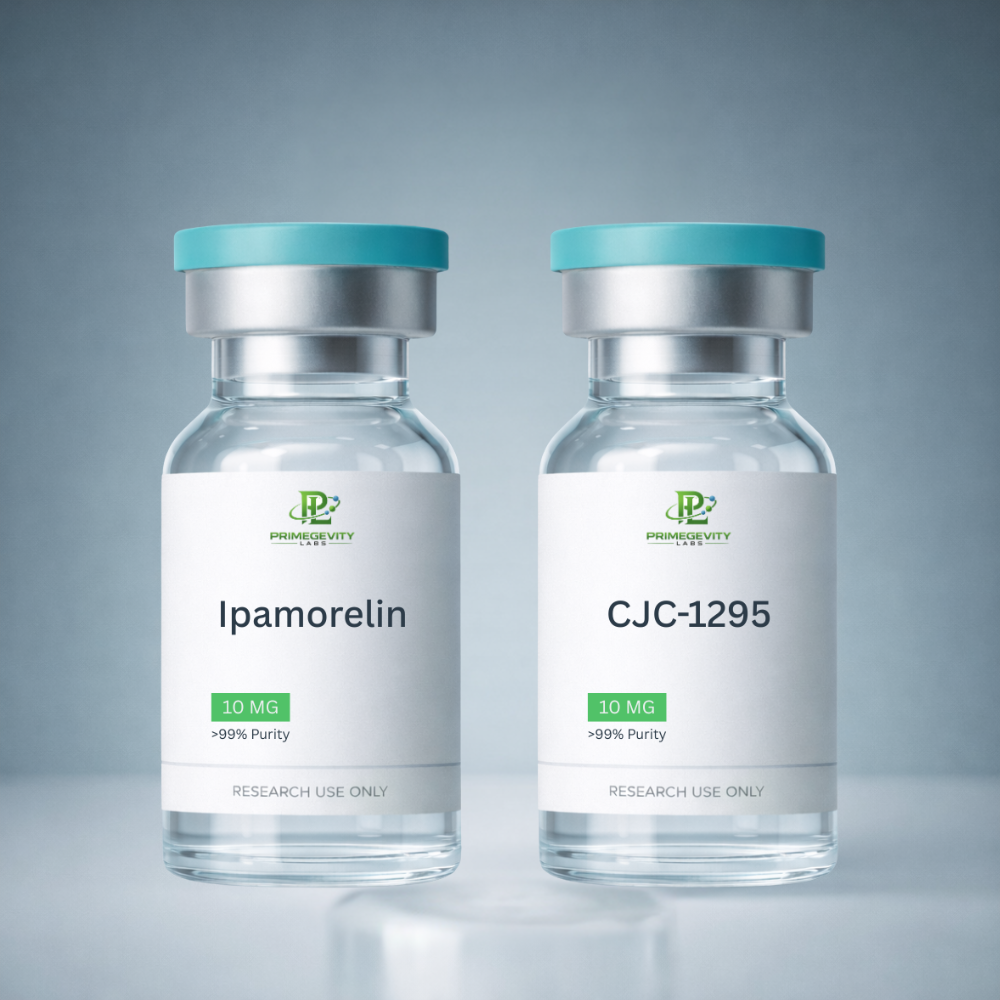
CJC-1295 (DAC/No-DAC)
CJC-1295 is a synthetic tetrasubstituted analogue of Growth Hormone-Releasing Hormone (GHRH), specifically modified from the 29-amino acid fragment of GHRH. It is engineered with four amino acid substitutions that enhance its resistance to enzymatic degradation, thereby extending its physiological half-life and biological activity compared to endogenous GHRH.
In controlled laboratory settings, CJC-1295 is a primary tool for probing the GHRH receptor (GHRHR) signaling axis, somatotroph cell activation, and the regulation of hepatic Insulin-Like Growth Factor 1 (IGF-1) production.
Key Features & Research Utility
-
Synthetic GHRH receptor agonist for endocrine pharmacology and growth axis studies.
-
High relevance to GHRH-mediated pulsatile growth hormone secretion.
-
Supports investigation of protein synthesis, muscle hypertrophy mechanisms, and lipid metabolism.
-
Commonly applied in models of growth hormone deficiency, lipodystrophy, and metabolic-reproductive health.
-
Suitable for both in vitro receptor-binding assays and in vivo pharmacokinetic research.
Biochemical Profile
| Property | Description |
| Compound Name | CJC-1295 (Modified GRF 1-29) |
| Peptide Class | GHRH Analogue / Growth Hormone Secretagogue |
| Amino Acid Sequence | Tyr-D-Ala-Asp-Ala-Ile-Phe-Thr-Gln-Ser-Tyr-Arg-Lys-Val-Leu-Ala-Gln-Leu-Ser-Ala-Arg-Lys-Leu-Leu-Gln-Asp-Ile-Leu-Ser-Arg-NH2 |
| Molecular Formula | $C_{165}H_{269}N_{47}O_{46}$ |
| Molecular Weight | ~3647.2 g/mol |
| CAS Number | 446262-90-4 |
| PubChem CID | 91971820 |
Mechanistic & Pathway Context
CJC-1295 functions by mimicking endogenous GHRH to bind and activate GHRH receptors on somatotroph cells in the anterior pituitary.
CJC-1295-mediated cellular responses are typically assessed through:
-
cAMP accumulation assays, measuring the activation of adenylate cyclase.
-
PKA-dependent phosphorylation, evaluating the downstream signaling of the GHRH receptor.
-
Plasma GH and IGF-1 profiling, monitoring long-term elevations in growth factors.
-
Somatotroph viability studies, exploring the impact of sustained receptor activation on pituitary health.
Research Applications
| Application Area | Experimental Focus |
| Endocrinology | GHRH receptor affinity, somatotroph responsiveness. |
| Metabolic Research | Lipolysis dynamics, insulin sensitivity, and visceral fat reduction. |
| Performance Biology | Muscle protein synthesis and recovery in injury models. |
| Pharmacokinetics | Half-life extension via tetrasubstitution or DAC technology. |
Ipamorelin (Growth Hormone / Performance)
Ipamorelin
Ipamorelin is a synthetic pentapeptide and a highly selective Growth Hormone Secretagogue Receptor (GHSR-1a) agonist, often classified as a ghrelin mimetic. Unlike earlier secretagogues, Ipamorelin is unique for its ability to stimulate pulsatile growth hormone (GH) release without significantly elevating plasma levels of cortisol, prolactin, or ACTH.
In research settings, Ipamorelin is utilized to investigate the ghrelin-somatotroph axis, gastrointestinal motility regulation, and the preservation of physiological GH pulsatility patterns.
Key Features & Research Utility
-
Selective GHSR-1a agonist for investigating ghrelin-like signaling pathways.
-
High relevance to endogenous growth hormone pulsatility and circadian rhythm modeling.
-
Supports investigation of bone mineral density, sleep architecture, and lipolytic pathways.
-
Commonly applied in models of sarcopenia, metabolic syndrome, and post-surgical recovery.
-
Distinguished by its minimal impact on secondary hormonal pathways (cortisol/prolactin).
Biochemical Profile
| Property | Description |
| Compound Name | Ipamorelin |
| Peptide Class | Ghrelin Mimetic / Growth Hormone Secretagogue |
| Amino Acid Sequence | Aib-His-D-2-Nal-D-Phe-Lys-NH2 |
| Molecular Formula | $C_{38}H_{49}N_9O_5$ |
| Molecular Weight | ~711.85 g/mol |
| CAS Number | 170851-70-4 |
| PubChem CID | 9831659 |
Mechanistic & Pathway Context
Ipamorelin functions by binding to the ghrelin receptor (GHSR-1a) in the pituitary and hypothalamus, triggering a rapid GH release that mirrors natural pulses.
Ipamorelin-mediated cellular responses are frequently assessed through:
-
GHSR-1a activation studies, focusing on enhanced cyclic adenosine monophosphate (cAMP) production.
-
PKA-mediated signaling, observing the direct activation of pituitary somatotrophs.
-
IGF-1 expression analysis, measuring the secondary stimulation of hepatic growth factor production.
-
Selectivity profiling, verifying the absence of glucocorticoid and lactotrophic signaling.
Research Applications
| Application Area | Experimental Focus |
| Bone Metabolism | Osteoblast activity and bone formation rates. |
| Somatic Research | Lean muscle mass enhancement and recovery from atrophy. |
| Neuro-Sleep Research | Slow-wave sleep duration and quality enhancement. |
| Metabolic Health | Visceral adipose reduction and insulin sensitivity improvement. |
Disclaimer & Legal Notice
-
These products are sold For Research Use Only (RUO).
-
Not for human or animal consumption.
-
Not approved for diagnostic, therapeutic, medical, or veterinary use.
-
This document is provided solely for general educational and informational purposes. It does NOT provide medical advice, dosing guidance, or treatment instructions. All information must be independently verified with a licensed medical professional. This document is intended to comply with applicable laws and regulations of the State of California.
| Size |
|---|
Related Products
Related products
-
CJC-1295
Price range: $85.00 through $140.00 Add to Cart Add to Cart This product has multiple variants. The options may be chosen on the product page
Reviews
There are no reviews yet.